Qwen3 4B Instruct 2507 FP8
par Qwen
Open source · 660k downloads · 74 likes
2.3
(74 avis)ChatAPI & LocalÀ propos
Le modèle Qwen3 4B Instruct 2507 FP8 est une version optimisée du modèle Qwen3, spécialement conçue pour exceller dans le suivi d’instructions, le raisonnement logique, la compréhension de texte et les tâches subjectives ou ouvertes. Grâce à des améliorations significatives, il offre une meilleure couverture des connaissances rares dans plusieurs langues et une compréhension approfondie de contextes longs, jusqu’à 256 000 tokens. Ses capacités étendues incluent la génération de texte de haute qualité, la résolution de problèmes mathématiques ou scientifiques, ainsi qu’une utilisation efficace d’outils, ce qui le rend particulièrement adapté aux applications nécessitant une interaction avancée. Ce modèle se distingue par sa précision accrue et son alignement renforcé avec les préférences utilisateur, garantissant des réponses plus pertinentes et naturelles. Il est idéal pour des usages variés, allant de l’assistance conversationnelle à l’automatisation de tâches complexes via des agents intelligents.
Documentation
Qwen3-4B-Instruct-2507-FP8

Highlights
We introduce the updated version of the Qwen3-4B-FP8 non-thinking mode, named Qwen3-4B-Instruct-2507-FP8, featuring the following key enhancements:
- Significant improvements in general capabilities, including instruction following, logical reasoning, text comprehension, mathematics, science, coding and tool usage.
- Substantial gains in long-tail knowledge coverage across multiple languages.
- Markedly better alignment with user preferences in subjective and open-ended tasks, enabling more helpful responses and higher-quality text generation.
- Enhanced capabilities in 256K long-context understanding.
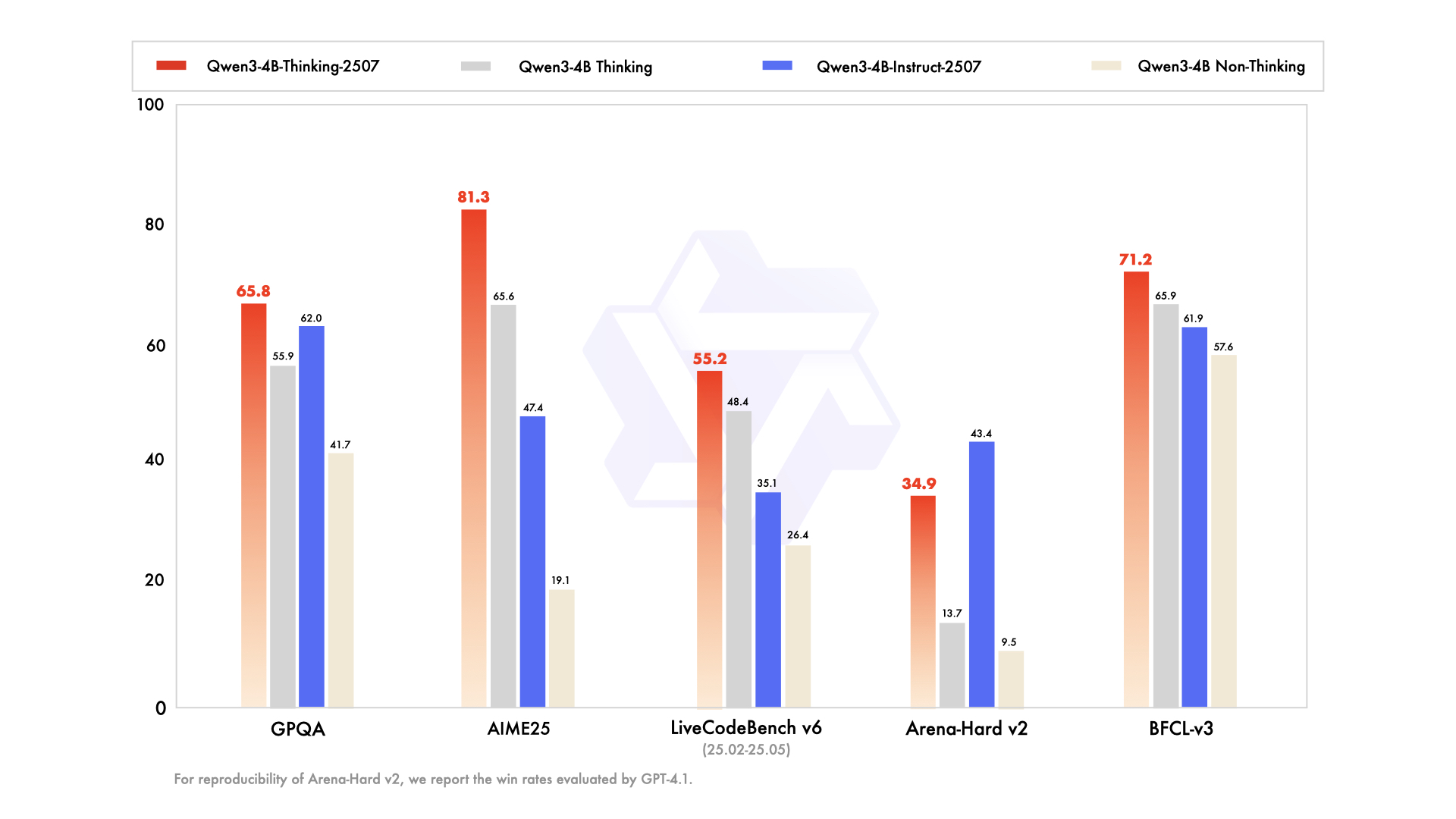
Model Overview
This repo contains the FP8 version of Qwen3-4B-Instruct-2507, which has the following features:
- Type: Causal Language Models
- Training Stage: Pretraining & Post-training
- Number of Parameters: 4.0B
- Number of Paramaters (Non-Embedding): 3.6B
- Number of Layers: 36
- Number of Attention Heads (GQA): 32 for Q and 8 for KV
- Context Length: 262,144 natively.
NOTE: This model supports only non-thinking mode and does not generate <think></think> blocks in its output. Meanwhile, specifying enable_thinking=False is no longer required.
For more details, including benchmark evaluation, hardware requirements, and inference performance, please refer to our blog, GitHub, and Documentation.
Performance
| GPT-4.1-nano-2025-04-14 | Qwen3-30B-A3B Non-Thinking | Qwen3-4B Non-Thinking | Qwen3-4B-Instruct-2507 | |
|---|---|---|---|---|
| Knowledge | ||||
| MMLU-Pro | 62.8 | 69.1 | 58.0 | 69.6 |
| MMLU-Redux | 80.2 | 84.1 | 77.3 | 84.2 |
| GPQA | 50.3 | 54.8 | 41.7 | 62.0 |
| SuperGPQA | 32.2 | 42.2 | 32.0 | 42.8 |
| Reasoning | ||||
| AIME25 | 22.7 | 21.6 | 19.1 | 47.4 |
| HMMT25 | 9.7 | 12.0 | 12.1 | 31.0 |
| ZebraLogic | 14.8 | 33.2 | 35.2 | 80.2 |
| LiveBench 20241125 | 41.5 | 59.4 | 48.4 | 63.0 |
| Coding | ||||
| LiveCodeBench v6 (25.02-25.05) | 31.5 | 29.0 | 26.4 | 35.1 |
| MultiPL-E | 76.3 | 74.6 | 66.6 | 76.8 |
| Aider-Polyglot | 9.8 | 24.4 | 13.8 | 12.9 |
| Alignment | ||||
| IFEval | 74.5 | 83.7 | 81.2 | 83.4 |
| Arena-Hard v2* | 15.9 | 24.8 | 9.5 | 43.4 |
| Creative Writing v3 | 72.7 | 68.1 | 53.6 | 83.5 |
| WritingBench | 66.9 | 72.2 | 68.5 | 83.4 |
| Agent | ||||
| BFCL-v3 | 53.0 | 58.6 | 57.6 | 61.9 |
| TAU1-Retail | 23.5 | 38.3 | 24.3 | 48.7 |
| TAU1-Airline | 14.0 | 18.0 | 16.0 | 32.0 |
| TAU2-Retail | - | 31.6 | 28.1 | 40.4 |
| TAU2-Airline | - | 18.0 | 12.0 | 24.0 |
| TAU2-Telecom | - | 18.4 | 17.5 | 13.2 |
| Multilingualism | ||||
| MultiIF | 60.7 | 70.8 | 61.3 | 69.0 |
| MMLU-ProX | 56.2 | 65.1 | 49.6 | 61.6 |
| INCLUDE | 58.6 | 67.8 | 53.8 | 60.1 |
| PolyMATH | 15.6 | 23.3 | 16.6 | 31.1 |
*: For reproducibility, we report the win rates evaluated by GPT-4.1.
Quickstart
The code of Qwen3 has been in the latest Hugging Face transformers and we advise you to use the latest version of transformers.
With transformers<4.51.0, you will encounter the following error:
VB.NET
KeyError: 'qwen3'
The following contains a code snippet illustrating how to use the model generate content based on given inputs.
Python
from transformers import AutoModelForCausalLM, AutoTokenizer

model_name = "Qwen/Qwen3-4B-Instruct-2507-FP8"

# load the tokenizer and the model
tokenizer = AutoTokenizer.from_pretrained(model_name)
model = AutoModelForCausalLM.from_pretrained(
    model_name,
    torch_dtype="auto",
    device_map="auto"
)

# prepare the model input
prompt = "Give me a short introduction to large language model."
messages = [
    {"role": "user", "content": prompt}
]
text = tokenizer.apply_chat_template(
    messages,
    tokenize=False,
    add_generation_prompt=True,
)
model_inputs = tokenizer([text], return_tensors="pt").to(model.device)

# conduct text completion
generated_ids = model.generate(
    **model_inputs,
    max_new_tokens=16384
)
output_ids = generated_ids[0][len(model_inputs.input_ids[0]):].tolist()

content = tokenizer.decode(output_ids, skip_special_tokens=True)

print("content:", content)
For deployment, you can use sglang>=0.4.6.post1 or vllm>=0.8.5 or to create an OpenAI-compatible API endpoint:
- SGLang:
Shell
python -m sglang.launch_server --model-path Qwen/Qwen3-4B-Instruct-2507-FP8 --context-length 262144 - vLLM:
Shell
vllm serve Qwen/Qwen3-4B-Instruct-2507-FP8 --max-model-len 262144
Note: If you encounter out-of-memory (OOM) issues, consider reducing the context length to a shorter value, such as 32,768.
For local use, applications such as Ollama, LMStudio, MLX-LM, llama.cpp, and KTransformers have also supported Qwen3.
Note on FP8
For convenience and performance, we have provided fp8-quantized model checkpoint for Qwen3, whose name ends with -FP8. The quantization method is fine-grained fp8 quantization with block size of 128. You can find more details in the quantization_config field in config.json.
You can use the Qwen3-4B-Instruct-2507-FP8 model with serveral inference frameworks, including transformers, sglang, and vllm, as the original bfloat16 model.
Agentic Use
Qwen3 excels in tool calling capabilities. We recommend using Qwen-Agent to make the best use of agentic ability of Qwen3. Qwen-Agent encapsulates tool-calling templates and tool-calling parsers internally, greatly reducing coding complexity.
To define the available tools, you can use the MCP configuration file, use the integrated tool of Qwen-Agent, or integrate other tools by yourself.
Python
from qwen_agent.agents import Assistant

# Define LLM
llm_cfg = {
    'model': 'Qwen3-4B-Instruct-2507-FP8',

    # Use a custom endpoint compatible with OpenAI API:
    'model_server': 'http://localhost:8000/v1',  # api_base
    'api_key': 'EMPTY',
}

# Define Tools
tools = [
    {'mcpServers': {  # You can specify the MCP configuration file
            'time': {
                'command': 'uvx',
                'args': ['mcp-server-time', '--local-timezone=Asia/Shanghai']
            },
            "fetch": {
                "command": "uvx",
                "args": ["mcp-server-fetch"]
            }
        }
    },
  'code_interpreter',  # Built-in tools
]

# Define Agent
bot = Assistant(llm=llm_cfg, function_list=tools)

# Streaming generation
messages = [{'role': 'user', 'content': 'https://qwenlm.github.io/blog/ Introduce the latest developments of Qwen'}]
for responses in bot.run(messages=messages):
    pass
print(responses)
Best Practices
To achieve optimal performance, we recommend the following settings:
-
Sampling Parameters:
- We suggest using
Temperature=0.7,TopP=0.8,TopK=20, andMinP=0. - For supported frameworks, you can adjust the
presence_penaltyparameter between 0 and 2 to reduce endless repetitions. However, using a higher value may occasionally result in language mixing and a slight decrease in model performance.
- We suggest using
-
Adequate Output Length: We recommend using an output length of 16,384 tokens for most queries, which is adequate for instruct models.
-
Standardize Output Format: We recommend using prompts to standardize model outputs when benchmarking.
- Math Problems: Include "Please reason step by step, and put your final answer within \boxed{}." in the prompt.
- Multiple-Choice Questions: Add the following JSON structure to the prompt to standardize responses: "Please show your choice in the
answerfield with only the choice letter, e.g.,"answer": "C"."
Citation
If you find our work helpful, feel free to give us a cite.
INI
@misc{qwen3technicalreport,
      title={Qwen3 Technical Report},
      author={Qwen Team},
      year={2025},
      eprint={2505.09388},
      archivePrefix={arXiv},
      primaryClass={cs.CL},
      url={https://arxiv.org/abs/2505.09388},
}
Liens & Ressources