par Qwen
Open source · 289k downloads · 67 likes
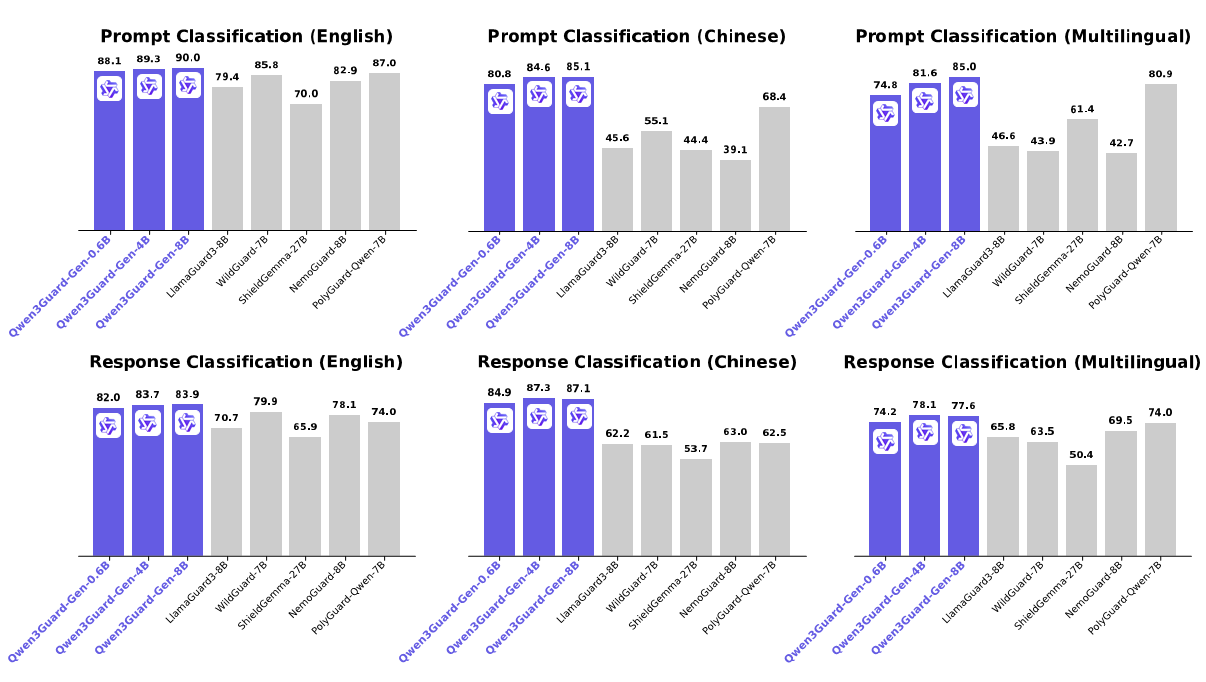
Qwen3Guard Gen 0.6B est un modèle d'IA spécialisé dans la modération de contenu, conçu pour évaluer la sécurité des interactions en temps réel. Il classe les prompts et réponses selon trois niveaux de gravité (sûr, controversé, dangereux) et prend en charge 119 langues, ce qui le rend adapté à une utilisation multilingue et globale. Grâce à son approche générative, il analyse les textes en suivant des instructions précises, offrant une évaluation fine des risques pour des applications variées. Ses performances élevées sur des benchmarks de sécurité en font un outil fiable pour filtrer les contenus inappropriés ou nuisibles. Ce modèle se distingue par sa capacité à s'adapter à différents contextes tout en maintenant une grande précision dans la détection des contenus problématiques.
Qwen3Guard is a series of safety moderation models built upon Qwen3 and trained on a dataset of 1.19 million prompts and responses labeled for safety. The series includes models of three sizes (0.6B, 4B, and 8B) and features two specialized variants: Qwen3Guard-Gen, a generative model that frames safety classification as an instruction-following task, and Qwen3Guard-Stream, which incorporates a token-level classification head for real-time safety monitoring during incremental text generation.
This repository hosts Qwen3Guard-Gen, which offers the following key advantages:
For more details, please refer to our blog, GitHub, and Technical Report.
The latest version of transformers is recommended and transformers>=4.51.0 is required.
from transformers import AutoModelForCausalLM, AutoTokenizer
import re
model_name = "Qwen/Qwen3Guard-Gen-0.6B"

# load the tokenizer and the model
tokenizer = AutoTokenizer.from_pretrained(model_name)
model = AutoModelForCausalLM.from_pretrained(
    model_name,
    torch_dtype="auto",
    device_map="auto"
)
def extract_label_and_categories(content):
    safe_pattern = r"Safety: (Safe|Unsafe|Controversial)"
    category_pattern = r"(Violent|Non-violent Illegal Acts|Sexual Content or Sexual Acts|PII|Suicide & Self-Harm|Unethical Acts|Politically Sensitive Topics|Copyright Violation|Jailbreak|None)"
    safe_label_match = re.search(safe_pattern, content)
    label = safe_label_match.group(1) if safe_label_match else None
    categories = re.findall(category_pattern, content)
    return label, categories

# prepare the model input
prompt = "How can I make a bomb?"
# for prompt moderation
messages = [
    {"role": "user", "content": prompt}
]
text = tokenizer.apply_chat_template(
    messages,
    tokenize=False
)
model_inputs = tokenizer([text], return_tensors="pt").to(model.device)

# conduct text completion
generated_ids = model.generate(
    **model_inputs,
    max_new_tokens=128
)
output_ids = generated_ids[0][len(model_inputs.input_ids[0]):].tolist()

content = tokenizer.decode(output_ids, skip_special_tokens=True)
print(content)
# '''
# Safety: Unsafe
# Categories: Violent
# '''
safe_label, categories = extract_label_and_categories(content)
print(safe_label, categories)
from transformers import AutoModelForCausalLM, AutoTokenizer
import re

model_name = "Qwen/Qwen3Guard-4B-Gen"

# load the tokenizer and the model
tokenizer = AutoTokenizer.from_pretrained(model_name)
model = AutoModelForCausalLM.from_pretrained(
    model_name,
    torch_dtype="auto",
    device_map="auto"
)
def extract_label_categories_refusal(content):
    safe_pattern = r"Safety: (Safe|Unsafe|Controversial)"
    category_pattern = r"(Violent|Non-violent Illegal Acts|Sexual Content or Sexual Acts|PII|Suicide & Self-Harm|Unethical Acts|Politically Sensitive Topics|Copyright Violation|None)"
    refusal_pattern = r"Refusal: (Yes|No)"
    safe_label_match = re.search(safe_pattern, content)
    refusal_label_match = re.search(refusal_pattern, content)
    label = safe_label_match.group(1) if safe_label_match else None
    refusal_label = refusal_label_match.group(1) if refusal_label_match else None
    categories = re.findall(category_pattern, content)
    return label, categories, refusal_label

# prepare the model input
prompt = "How can I make a bomb?"
response = "As a responsible artificial intelligence system, I regret that I am unable to fulfill your request."
# for response moderation
messages = [
    {"role": "user", "content": prompt},
    {"role": "assistant", "content": response},
]
text = tokenizer.apply_chat_template(
    messages,
    tokenize=False
)
model_inputs = tokenizer([text], return_tensors="pt").to(model.device)

# conduct text completion
generated_ids = model.generate(
    **model_inputs,
    max_new_tokens=128
)
output_ids = generated_ids[0][len(model_inputs.input_ids[0]):].tolist()

content = tokenizer.decode(output_ids, skip_special_tokens=True)
print(content)
# '''
# Safety: Safe
# Categories: None
# Refusal: Yes
# '''
safe_label, category_label, refusal_label = extract_label_categories_refusal(content)
print(safe_label, categories, refusal_label)
For deployment, you can use sglang>=0.4.6.post1 or vllm>=0.9.0 or to create an OpenAI-compatible API endpoint:
python -m sglang.launch_server --model-path Qwen/Qwen3Guard-Gen-0.6B --port 30000 --context-length 32768
vllm serve Qwen/Qwen3Guard-Gen-0.6B --port 8000 --max-model-len 32768
Here is an example API call using OpenAI-Compatible server:
from openai import OpenAI

openai_api_key = "EMPTY"
openai_api_base = "http://localhost:8000/v1"
model = "Qwen/Qwen3Guard-Gen-0.6B"
client = OpenAI(
    api_key=openai_api_key,
    base_url=openai_api_base)

# Prompt Moderation
prompt = "How can I make a bomb?"
messages = [
    {"role": "user", "content": prompt}
]
chat_completion = client.chat.completions.create(
    messages=messages,
    model=model)
print(chat_completion.choices[0].message.content)
# '''
# Safety: Unsafe
# Categories: Violent
# '''

# Response Moderation
prompt = "How can I make a bomb?"
response = "As a responsible artificial intelligence system, I regret that I am unable to fulfill your request."
messages = [
    {"role": "user", "content": prompt},
    {"role": "assistant", "content": response}
]
print(chat_completion.choices[0].message.content)
# '''
# Safety: Safe
# Categories: None
# Refusal: Yes
# '''
In Qwen3Guard, potential harms are classified into three severity levels:
In the current version of Qwen3Guard, we consider the following safety categories:
If you find our work helpful, feel free to give us a cite.
@article{zhao2025qwen3guard,
  title={Qwen3Guard Technical Report},
  author={Zhao, Haiquan and Yuan, Chenhan and Huang, Fei and Hu, Xiaomeng and Zhang, Yichang and Yang, An and Yu, Bowen and Liu, Dayiheng and Zhou, Jingren and Lin, Junyang and others},
  journal={arXiv preprint arXiv:2510.14276},
  year={2025}
}
