par unsloth
Open source · 147k downloads · 590 likes
Le modèle Qwen3 Coder 30B A3B Instruct est une intelligence artificielle spécialisée dans la programmation et les tâches liées au code, optimisée pour des performances élevées tout en restant efficace. Il excelle particulièrement dans les applications de codage agentique, comme l'automatisation de tâches de développement ou l'interaction avec des environnements de programmation, et supporte une large fenêtre de contexte allant jusqu'à 256 000 tokens, extensible à 1 million avec des techniques comme Yarn. Conçu pour comprendre et générer du code à l'échelle d'un dépôt, il se distingue par sa capacité à gérer des projets complexes et à interagir avec des outils comme Qwen Code ou CLINE grâce à un format d'appel de fonctions dédié. Son architecture allégée, avec seulement 3,3 milliards de paramètres activés sur 30,5 milliards au total, le rend accessible pour des déploiements locaux tout en conservant une grande puissance. Idéal pour les développeurs, les équipes techniques ou les chercheurs, il facilite la productivité en automatisant des tâches répétitives ou en assistant dans l'analyse de code à grande échelle.
See our collection for all versions of Qwen3 including GGUF, 4-bit & 16-bit formats.
Learn to run Qwen3-Coder correctly - Read our Guide.
See Unsloth Dynamic 2.0 GGUFs for our quantization benchmarks.




Qwen3-Coder is available in multiple sizes. Today, we're excited to introduce Qwen3-Coder-30B-A3B-Instruct. This streamlined model maintains impressive performance and efficiency, featuring the following key enhancements:
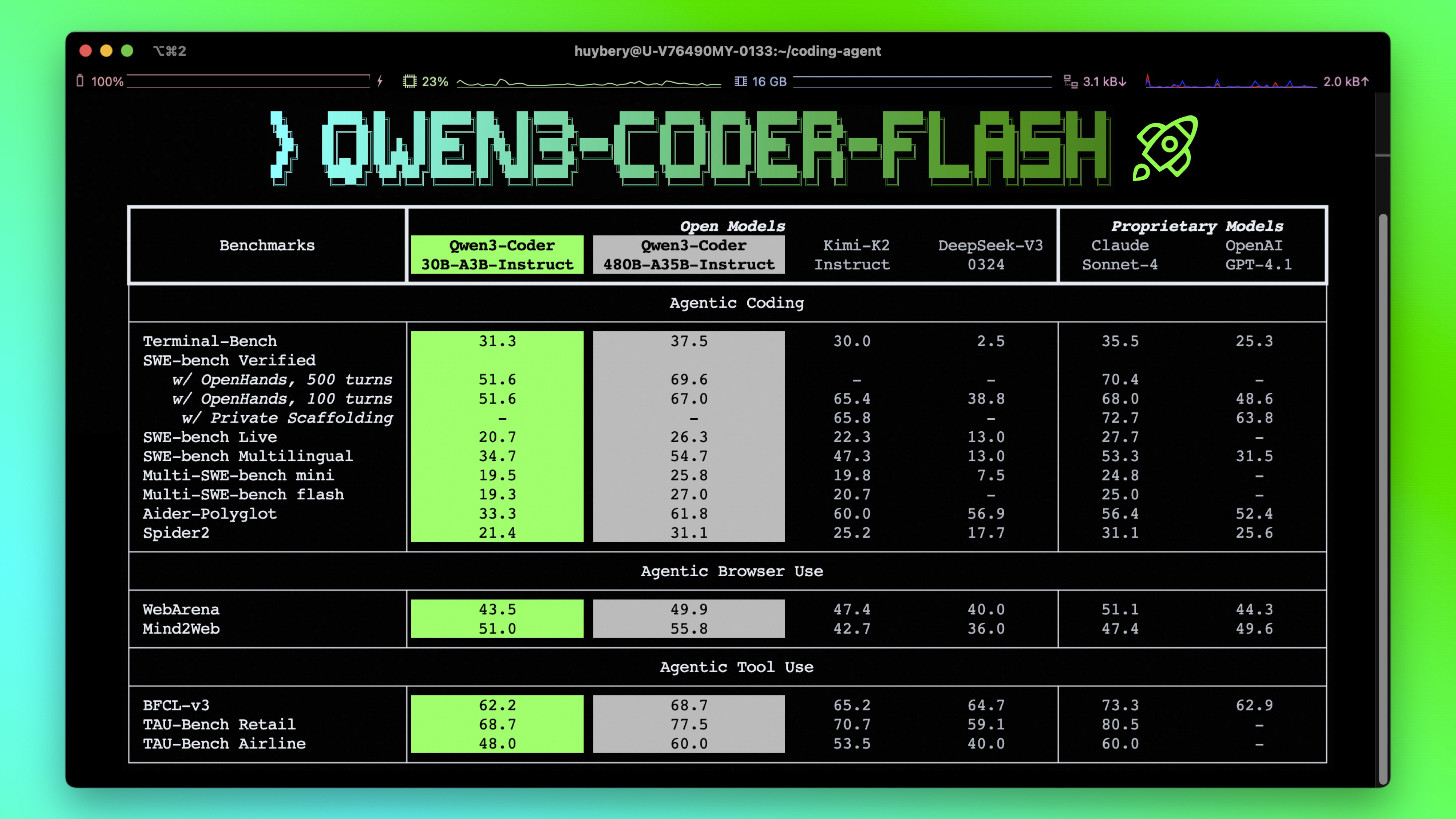
Qwen3-Coder-30B-A3B-Instruct has the following features:
NOTE: This model supports only non-thinking mode and does not generate <think></think> blocks in its output. Meanwhile, specifying enable_thinking=False is no longer required.
For more details, including benchmark evaluation, hardware requirements, and inference performance, please refer to our blog, GitHub, and Documentation.
We advise you to use the latest version of transformers.
With transformers<4.51.0, you will encounter the following error:
KeyError: 'qwen3_moe'
The following contains a code snippet illustrating how to use the model generate content based on given inputs.
from transformers import AutoModelForCausalLM, AutoTokenizer

model_name = "Qwen/Qwen3-Coder-30B-A3B-Instruct"

# load the tokenizer and the model
tokenizer = AutoTokenizer.from_pretrained(model_name)
model = AutoModelForCausalLM.from_pretrained(
    model_name,
    torch_dtype="auto",
    device_map="auto"
)

# prepare the model input
prompt = "Write a quick sort algorithm."
messages = [
    {"role": "user", "content": prompt}
]
text = tokenizer.apply_chat_template(
    messages,
    tokenize=False,
    add_generation_prompt=True,
)
model_inputs = tokenizer([text], return_tensors="pt").to(model.device)

# conduct text completion
generated_ids = model.generate(
    **model_inputs,
    max_new_tokens=65536
)
output_ids = generated_ids[0][len(model_inputs.input_ids[0]):].tolist()

content = tokenizer.decode(output_ids, skip_special_tokens=True)

print("content:", content)
Note: If you encounter out-of-memory (OOM) issues, consider reducing the context length to a shorter value, such as 32,768.
For local use, applications such as Ollama, LMStudio, MLX-LM, llama.cpp, and KTransformers have also supported Qwen3.
Qwen3-Coder excels in tool calling capabilities.
You can simply define or use any tools as following example.
# Your tool implementation
def square_the_number(num: float) -> dict:
    return num ** 2

# Define Tools
tools=[
    {
        "type":"function",
        "function":{
            "name": "square_the_number",
            "description": "output the square of the number.",
            "parameters": {
                "type": "object",
                "required": ["input_num"],
                "properties": {
                    'input_num': {
                        'type': 'number',
                        'description': 'input_num is a number that will be squared'
                        }
                },
            }
        }
    }
]

import OpenAI
# Define LLM
client = OpenAI(
    # Use a custom endpoint compatible with OpenAI API
    base_url='http://localhost:8000/v1',  # api_base
    api_key="EMPTY"
)

messages = [{'role': 'user', 'content': 'square the number 1024'}]

completion = client.chat.completions.create(
    messages=messages,
    model="Qwen3-Coder-30B-A3B-Instruct",
    max_tokens=65536,
    tools=tools,
)

print(completion.choice[0])
To achieve optimal performance, we recommend the following settings:
Sampling Parameters:
temperature=0.7, top_p=0.8, top_k=20, repetition_penalty=1.05.Adequate Output Length: We recommend using an output length of 65,536 tokens for most queries, which is adequate for instruct models.
If you find our work helpful, feel free to give us a cite.
@misc{qwen3technicalreport,
      title={Qwen3 Technical Report},
      author={Qwen Team},
      year={2025},
      eprint={2505.09388},
      archivePrefix={arXiv},
      primaryClass={cs.CL},
      url={https://arxiv.org/abs/2505.09388},
}
