by deepseek-ai
Open source · 234k downloads · 170 likes
DeepSeek V2 Lite is an advanced Mixture-of-Experts (MoE) language model designed to balance performance and efficiency. With a total of just 16 billion parameters (of which 2.4 billion are active), it outperforms similarly sized dense models on numerous English and Chinese benchmarks. Thanks to its optimized architecture, it can be deployed on a single 40GB GPU and fine-tuned across eight 80GB GPUs, making it accessible for large-scale applications. Its key innovations, such as multi-head latent attention (MLA), significantly reduce the memory required for KV caching, enhancing inference efficiency. Ideal for developers and researchers, it stands out for its balance of power, reduced cost, and ease of use.









Model Download | Evaluation Results | Model Architecture | API Platform | License | Citation
Last week, the release and buzz around DeepSeek-V2 have ignited widespread interest in MLA (Multi-head Latent Attention)! Many in the community suggested open-sourcing a smaller MoE model for in-depth research. And now DeepSeek-V2-Lite comes out:
DeepSeek-V2, a strong Mixture-of-Experts (MoE) language model characterized by economical training and efficient inference. DeepSeek-V2 adopts innovative architectures including Multi-head Latent Attention (MLA) and DeepSeekMoE. MLA guarantees efficient inference through significantly compressing the Key-Value (KV) cache into a latent vector, while DeepSeekMoE enables training strong models at an economical cost through sparse computation.
With DeepSeek-V2, we are open-sourcing base and chat models across two sizes:
| Model | #Total Params | #Activated Params | Context Length | Download |
|---|---|---|---|---|
| DeepSeek-V2-Lite | 16B | 2.4B | 32k | 🤗 HuggingFace |
| DeepSeek-V2-Lite-Chat (SFT) | 16B | 2.4B | 32k | 🤗 HuggingFace |
| DeepSeek-V2 | 236B | 21B | 128k | 🤗 HuggingFace |
| DeepSeek-V2-Chat (RL) | 236B | 21B | 128k | 🤗 HuggingFace |
Due to the constraints of HuggingFace, the open-source code currently experiences slower performance than our internal codebase when running on GPUs with Huggingface. To facilitate the efficient execution of our model, we offer a dedicated vllm solution that optimizes performance for running our model effectively.
| Benchmark | Domain | DeepSeek 7B (Dense) | DeepSeekMoE 16B | DeepSeek-V2-Lite (MoE-16B) |
|---|---|---|---|---|
| Architecture | - | MHA+Dense | MHA+MoE | MLA+MoE |
| MMLU | English | 48.2 | 45.0 | 58.3 |
| BBH | English | 39.5 | 38.9 | 44.1 |
| C-Eval | Chinese | 45.0 | 40.6 | 60.3 |
| CMMLU | Chinese | 47.2 | 42.5 | 64.3 |
| HumanEval | Code | 26.2 | 26.8 | 29.9 |
| MBPP | Code | 39.0 | 39.2 | 43.2 |
| GSM8K | Math | 17.4 | 18.8 | 41.1 |
| Math | Math | 3.3 | 4.3 | 17.1 |
| Benchmark | Domain | DeepSeek 7B Chat (SFT) | DeepSeekMoE 16B Chat (SFT) | DeepSeek-V2-Lite 16B Chat (SFT) |
|---|---|---|---|---|
| MMLU | English | 49.7 | 47.2 | 55.7 |
| BBH | English | 43.1 | 42.2 | 48.1 |
| C-Eval | Chinese | 44.7 | 40.0 | 60.1 |
| CMMLU | Chinese | 51.2 | 49.3 | 62.5 |
| HumanEval | Code | 45.1 | 45.7 | 57.3 |
| MBPP | Code | 39.0 | 46.2 | 45.8 |
| GSM8K | Math | 62.6 | 62.2 | 72.0 |
| Math | Math | 14.7 | 15.2 | 27.9 |
DeepSeek-V2 adopts innovative architectures to guarantee economical training and efficient inference:
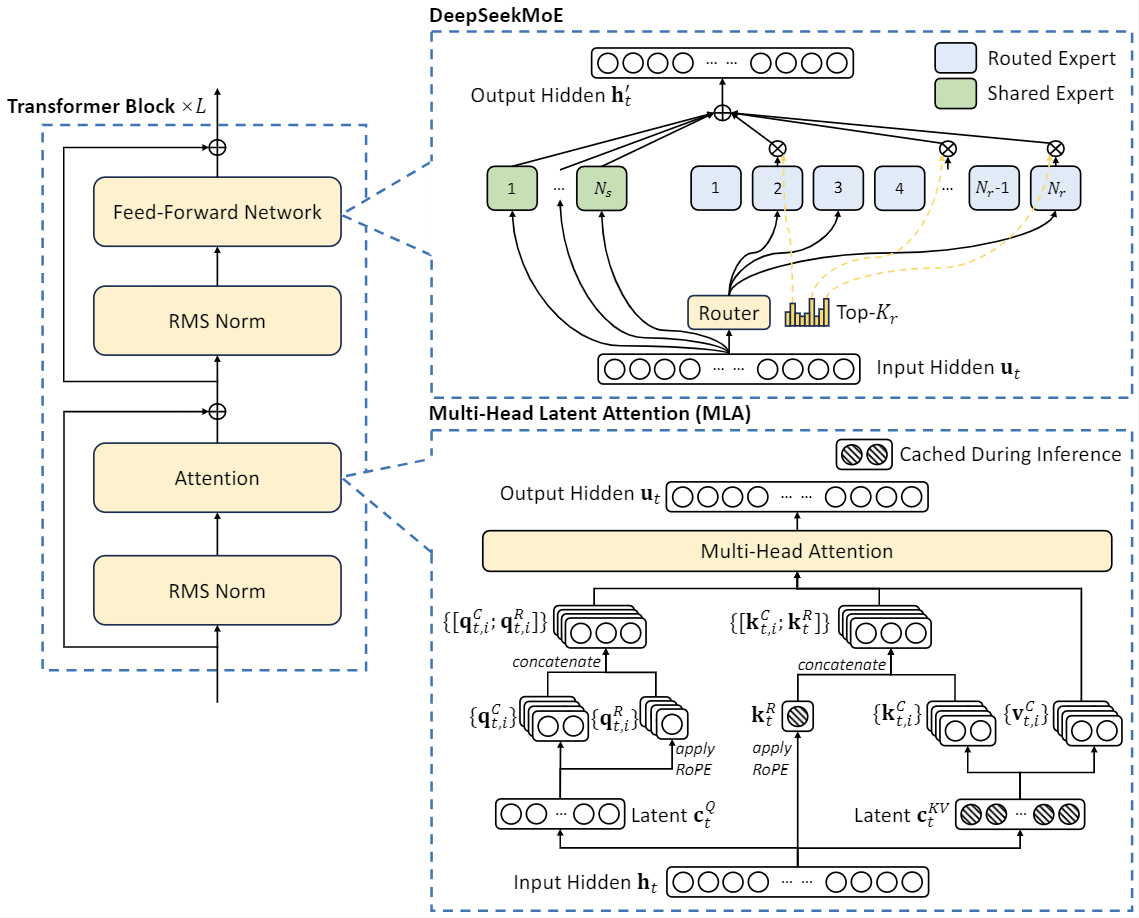
DeepSeek-V2-Lite has 27 layers and a hidden dimension of 2048. It also employs MLA and has 16 attention heads, where each head has a dimension of 128. Its KV compression dimension is 512, but slightly different from DeepSeek-V2, it does not compress the queries. For the decoupled queries and key, it has a per-head dimension of 64. DeepSeek-V2-Lite also employs DeepSeekMoE, and all FFNs except for the first layer are replaced with MoE layers. Each MoE layer consists of 2 shared experts and 64 routed experts, where the intermediate hidden dimension of each expert is 1408. Among the routed experts, 6 experts will be activated for each token. Under this configuration, DeepSeek-V2-Lite comprises 15.7B total parameters, of which 2.4B are activated for each token.
DeepSeek-V2-Lite is also trained from scratch on the same pre-training corpus of DeepSeek-V2, which is not polluted by any SFT data. It uses the AdamW optimizer with hyper-parameters set to $\beta_1=0.9$, $\beta_2=0.95$, and $\mathrm{weight_decay}=0.1$. The learning rate is scheduled using a warmup-and-step-decay strategy. Initially, the learning rate linearly increases from 0 to the maximum value during the first 2K steps. Subsequently, the learning rate is multiplied by 0.316 after training about 80% of tokens, and again by 0.316 after training about 90% of tokens. The maximum learning rate is set to $4.2 \times 10^{-4}$, and the gradient clipping norm is set to 1.0. We do not employ the batch size scheduling strategy for it, and it is trained with a constant batch size of 4608 sequences. During pre-training, we set the maximum sequence length to 4K, and train DeepSeek-V2-Lite on 5.7T tokens. We leverage pipeline parallelism to deploy different layers of it on different devices, but for each layer, all experts will be deployed on the same device. Therefore, we only employ a small expert-level balance loss with $\alpha_{1}=0.001$, and do not employ device-level balance loss and communication balance loss for it. After pre-training, we also perform long-context extension, SFT for DeepSeek-V2-Lite and get a chat model called DeepSeek-V2-Lite Chat.
To utilize DeepSeek-V2-Lite in BF16 format for inference, 40GB*1 GPU is required.
You can directly employ Huggingface's Transformers for model inference.
import torch
from transformers import AutoTokenizer, AutoModelForCausalLM, GenerationConfig

model_name = "deepseek-ai/DeepSeek-V2-Lite"
tokenizer = AutoTokenizer.from_pretrained(model_name, trust_remote_code=True)
model = AutoModelForCausalLM.from_pretrained(model_name, trust_remote_code=True, torch_dtype=torch.bfloat16).cuda()
model.generation_config = GenerationConfig.from_pretrained(model_name)
model.generation_config.pad_token_id = model.generation_config.eos_token_id

text = "An attention function can be described as mapping a query and a set of key-value pairs to an output, where the query, keys, values, and output are all vectors. The output is"
inputs = tokenizer(text, return_tensors="pt")
outputs = model.generate(**inputs.to(model.device), max_new_tokens=100)

result = tokenizer.decode(outputs[0], skip_special_tokens=True)
print(result)
import torch
from transformers import AutoTokenizer, AutoModelForCausalLM, GenerationConfig

model_name = "deepseek-ai/DeepSeek-V2-Lite-Chat"
tokenizer = AutoTokenizer.from_pretrained(model_name, trust_remote_code=True)
model = AutoModelForCausalLM.from_pretrained(model_name, trust_remote_code=True, torch_dtype=torch.bfloat16).cuda()
model.generation_config = GenerationConfig.from_pretrained(model_name)
model.generation_config.pad_token_id = model.generation_config.eos_token_id

messages = [
    {"role": "user", "content": "Write a piece of quicksort code in C++"}
]
input_tensor = tokenizer.apply_chat_template(messages, add_generation_prompt=True, return_tensors="pt")
outputs = model.generate(input_tensor.to(model.device), max_new_tokens=100)

result = tokenizer.decode(outputs[0][input_tensor.shape[1]:], skip_special_tokens=True)
print(result)
The complete chat template can be found within tokenizer_config.json located in the huggingface model repository.
An example of chat template is as belows:
<|begin▁of▁sentence|>User: {user_message_1}

Assistant: {assistant_message_1}<|end▁of▁sentence|>User: {user_message_2}

Assistant:
You can also add an optional system message:
<|begin▁of▁sentence|>{system_message}

User: {user_message_1}

Assistant: {assistant_message_1}<|end▁of▁sentence|>User: {user_message_2}

Assistant:
To utilize vLLM for model inference, please merge this Pull Request into your vLLM codebase: https://github.com/vllm-project/vllm/pull/4650.
from transformers import AutoTokenizer
from vllm import LLM, SamplingParams

max_model_len, tp_size = 8192, 1
model_name = "deepseek-ai/DeepSeek-V2-Lite-Chat"
tokenizer = AutoTokenizer.from_pretrained(model_name)
llm = LLM(model=model_name, tensor_parallel_size=tp_size, max_model_len=max_model_len, trust_remote_code=True, enforce_eager=True)
sampling_params = SamplingParams(temperature=0.3, max_tokens=256, stop_token_ids=[tokenizer.eos_token_id])

messages_list = [
    [{"role": "user", "content": "Who are you?"}],
    [{"role": "user", "content": "Translate the following content into Chinese directly: DeepSeek-V2 adopts innovative architectures to guarantee economical training and efficient inference."}],
    [{"role": "user", "content": "Write a piece of quicksort code in C++."}],
]

prompt_token_ids = [tokenizer.apply_chat_template(messages, add_generation_prompt=True) for messages in messages_list]

outputs = llm.generate(prompt_token_ids=prompt_token_ids, sampling_params=sampling_params)

generated_text = [output.outputs[0].text for output in outputs]
print(generated_text)
Since our API is compatible with OpenAI, you can easily use it in langchain. Here is an example:
from langchain_openai import ChatOpenAI
llm = ChatOpenAI(
    model='deepseek-chat',
    openai_api_key=<your-deepseek-api-key>,
    openai_api_base='https://api.deepseek.com/v1',
    temperature=0.85,
    max_tokens=8000)
This code repository is licensed under the MIT License. The use of DeepSeek-V2 Base/Chat models is subject to the Model License. DeepSeek-V2 series (including Base and Chat) supports commercial use.
@misc{deepseekv2,
      title={DeepSeek-V2: A Strong, Economical, and Efficient Mixture-of-Experts Language Model},
      author={DeepSeek-AI},
      year={2024},
      eprint={2405.04434},
      archivePrefix={arXiv},
      primaryClass={cs.CL}
}
If you have any questions, please raise an issue or contact us at [email protected].
