wavlm base
by microsoft
Open source · 25k downloads · 11 likes
1.3
(11 reviews)EmbeddingAPI & LocalAbout
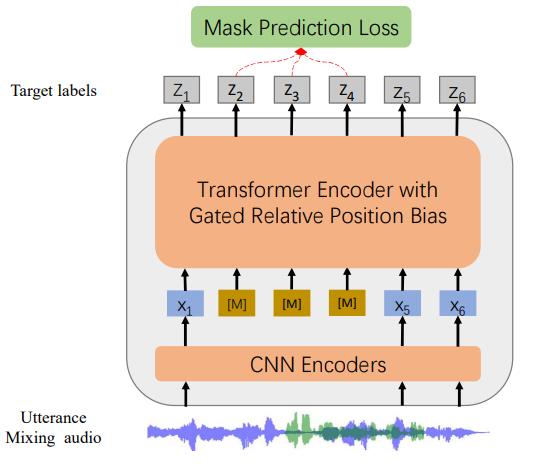
WavLM Base is an automatic speech processing model developed by Microsoft, designed to serve as a foundation for various tasks such as speech recognition, audio classification, or speaker verification. Trained on 960 hours of English data at a sampling rate of 16 kHz, it captures rich representations of the vocal signal, encompassing both spoken content and traits like speaker identity. Although pre-trained without a tokenizer, it requires fine-tuning on labeled data for practical applications, such as automatic transcription or speech analysis. This model stands out for its universal approach, optimized to perform well on the SUPERB benchmark, and for innovations like the addition of relative positional bias and a training strategy involving utterance mixing to enhance speaker discrimination. It is particularly well-suited for projects requiring a deep understanding of English speech but demands fine-tuning to reach full operational capability.
Documentation
WavLM-Base
The base model pretrained on 16kHz sampled speech audio. When using the model, make sure that your speech input is also sampled at 16kHz.
Note: This model does not have a tokenizer as it was pretrained on audio alone. In order to use this model speech recognition, a tokenizer should be created and the model should be fine-tuned on labeled text data. Check out this blog for more in-detail explanation of how to fine-tune the model.
The model was pre-trained on 960h of Librispeech.
Paper: WavLM: Large-Scale Self-Supervised Pre-Training for Full Stack Speech Processing
Authors: Sanyuan Chen, Chengyi Wang, Zhengyang Chen, Yu Wu, Shujie Liu, Zhuo Chen, Jinyu Li, Naoyuki Kanda, Takuya Yoshioka, Xiong Xiao, Jian Wu, Long Zhou, Shuo Ren, Yanmin Qian, Yao Qian, Jian Wu, Michael Zeng, Furu Wei
Abstract Self-supervised learning (SSL) achieves great success in speech recognition, while limited exploration has been attempted for other speech processing tasks. As speech signal contains multi-faceted information including speaker identity, paralinguistics, spoken content, etc., learning universal representations for all speech tasks is challenging. In this paper, we propose a new pre-trained model, WavLM, to solve full-stack downstream speech tasks. WavLM is built based on the HuBERT framework, with an emphasis on both spoken content modeling and speaker identity preservation. We first equip the Transformer structure with gated relative position bias to improve its capability on recognition tasks. For better speaker discrimination, we propose an utterance mixing training strategy, where additional overlapped utterances are created unsupervisely and incorporated during model training. Lastly, we scale up the training dataset from 60k hours to 94k hours. WavLM Large achieves state-of-the-art performance on the SUPERB benchmark, and brings significant improvements for various speech processing tasks on their representative benchmarks.
The original model can be found under https://github.com/microsoft/unilm/tree/master/wavlm.
Usage
This is an English pre-trained speech model that has to be fine-tuned on a downstream task like speech recognition or audio classification before it can be used in inference. The model was pre-trained in English and should therefore perform well only in English. The model has been shown to work well on the SUPERB benchmark.
Note: The model was pre-trained on phonemes rather than characters. This means that one should make sure that the input text is converted to a sequence of phonemes before fine-tuning.
Speech Recognition
To fine-tune the model for speech recognition, see the official speech recognition example.
Speech Classification
To fine-tune the model for speech classification, see the official audio classification example.
Speaker Verification
TODO
Speaker Diarization
TODO
Contribution
The model was contributed by cywang and patrickvonplaten.
License
The official license can be found here
Capabilities & Tags
transformerspytorchwavlmfeature-extractionspeechen
Links & Resources